

The rules of career advancement have changed. If you’re still relying on “working hard” and “waiting your turn,” you’re already falling behind.
According to the World Economic Forum’s Future of Jobs Report 2025, 44% of workers’ core skills will be disrupted in the next five years. The skills that secured your current position are unlikely to be the ones that earn you your next promotion.
In this comprehensive guide, I’ll walk you through the key skills needed for career advancement in the coming year—skills that are not just “nice to have” but essential for anyone serious about climbing the corporate ladder or transitioning into higher-paying roles.
Let’s start with an uncomfortable truth: loyalty and experience are no longer guarantees of promotion.
A LinkedIn Workplace Learning Report found that 89% of L&D professionals agree that proactively building employee skills will help navigate the evolving future of work. Yet, most employees are reactive—they wait until they’re passed over for a promotion before they start upskilling.
The “Skillset Expiration” Problem
Here’s what’s happening in the modern workplace:
- AI is automating routine tasks, making purely technical skills less valuable
- Remote and hybrid work has changed how visibility and impact are measured
- Cross-functional collaboration is now expected, not optional
- Soft skills are becoming hard requirements for leadership roles
Key Insight: The World Economic Forum estimates that 50% of all employees will need reskilling by 2027. The question isn’t if you need new skills—it’s which ones will give you the highest return on investment.
Skill 1: AI Fluency – From User to Architect


Alt text: Professional working alongside AI tools to automate workflows
Everyone can type a question into ChatGPT. That’s not a career differentiator anymore.
AI fluency in 2026 means understanding how to build AI-powered workflows that save your team hours of manual work. It means knowing when to use AI and—equally important—when human judgment is irreplaceable.
What AI Fluency Actually Looks Like
| Basic AI User | AI-Fluent Professional |
|---|---|
| Asks ChatGPT to write emails | Builds automated email sequences with AI triggers |
| Uses AI for research | Creates custom AI agents for specific business tasks |
| Knows one AI tool | Connects multiple AI tools (Zapier, Make, Claude) into workflows |
| Follows AI trends | Evaluates AI tools for ROI and implementation |
How to Develop AI Fluency
- Start with automation: Learn tools like Zapier or Make to connect your existing apps
- Master prompting: Move beyond basic prompts to iterative, multi-step conversations
- Understand limitations: Know when AI outputs need human verification
- Document your wins: Track time saved and present these metrics to leadership
Pro Tip: The professional who saves their team 10 hours/week through AI automation becomes indispensable—not replaceable.
Skill 2: Data Storytelling & Analytical Thinking


Alt text: Professional presenting data insights with compelling visualizations
Companies are drowning in data but starving for insights.
The ability to look at a spreadsheet and extract a compelling narrative—one that drives action—is one of the most valuable skills you can develop for career advancement.
The Difference Between Data Reporting and Data Storytelling
Data Reporting (Low Value):
“Sales increased by 12% this quarter.”
Data Storytelling (High Value):
“Sales increased by 12% this quarter, driven primarily by our new onboarding sequence. If we apply the same approach to our enterprise segment, we could see an additional $2.3M in revenue next quarter. Here’s the 3-step plan to make it happen.”
Key Components of Effective Data Storytelling
- Context: Why does this data matter right now?
- Insight: What is this data telling us that isn’t obvious?
- Recommendation: What should we do differently based on this data?
- Impact: What happens if we act vs. don’t act? Tools to Master for Data Storytelling
- Excel/Google Sheets: Still the foundation—master pivot tables and data visualization
- Tableau or Power BI: For more complex visualizations
- Looker Studio (free): Google’s free alternative for dashboard creation
- Canva: For making data visually compelling in presentations
Skill 3: Emotional Intelligence & Conflict Resolution

As AI takes over analytical and repetitive tasks, the premium on human skills is increasing exponentially.
According to research from Harvard Business Review, emotional intelligence accounts for nearly 90% of what sets high performers apart from peers with similar technical skills.
The Five Pillars of Workplace EQ
| Pillar | What It Means | How to Develop It |
|---|---|---|
| Self-Awareness | Knowing your triggers and blind spots | Regular reflection, 360 feedback |
| Self-Regulation | Controlling impulsive reactions | Pause before responding, journaling |
| Motivation | Internal drive beyond external rewards | Connect daily tasks to bigger purpose |
| Empathy | Understanding others’ perspectives | Active listening, asking questions |
| Social Skills | Navigating relationships effectively | Practice difficult conversations |
Real-World Application: Conflict Resolution
I recently observed a project fail—not because the technology was wrong, but because two department heads couldn’t agree on ownership. The manager who stepped in, facilitated a neutral conversation, and found a compromise was promoted within three months.
That visibility in conflict resolution is career gold.
How to Practice Conflict Resolution
- Volunteer for cross-functional projects where disagreements are likely
- Use the “Interests, Not Positions” framework: Ask “Why do you need that?” instead of arguing about what they’re asking for
- Document resolutions: Keep a record of conflicts you’ve helped resolve for performance reviews
Skill 4: Strategic Visibility & Personal Branding


Alt text: Professional networking and building their personal brand
In remote and hybrid work environments, “out of sight” often means “out of mind” when promotion decisions are made.
Strategic visibility isn’t about self-promotion or bragging. It’s about ensuring decision-makers are aware of your contributions when it matters.
The Weekly Visibility System
Here’s a simple system I recommend to all my coaching clients:
Every Friday, send your manager a 3-2-1 update:
- 3 wins from the week (with quantifiable impact if possible)
- 2 challenges you’re navigating (shows self-awareness)
- 1 goal for next week (shows initiative)
This creates a paper trail of your value and makes performance reviews much easier—for both you and your manager.
Internal vs. External Visibility
| Internal Visibility | External Visibility |
|---|---|
| Speaking up in meetings | LinkedIn thought leadership |
| Sharing wins with leadership | Industry conference speaking |
| Cross-department collaboration | Professional community involvement |
| Mentoring junior colleagues | Podcast/webinar appearances |
Warning: External visibility without internal results can backfire. Build your internal reputation first, then extend outward.
Practical Steps to Increase Visibility
- Ask for stretch assignments: Volunteer for high-visibility projects
- Share knowledge: Write internal documentation or lead training sessions
- Build relationships up and across: Don’t just network with peers—connect with leadership
- Document everything: Keep a “brag file” of accomplishments for review time
Skill 5: Deep Focus & Productivity Mastery

We live in an era of constant distraction. The average professional checks their phone 96 times per day according to Asurion research.
The ability to focus deeply for extended periods is becoming a rare and valuable skill.
The “Deep Work” Advantage
Cal Newport, author of Deep Work, argues that the ability to focus without distraction on cognitively demanding tasks is becoming increasingly rare and increasingly valuable.
Here’s the math:
- Most professionals get 2-3 hours of actual focused work per day
- If you can consistently achieve 4-5 hours of deep work, you’re producing 50-100% more valuable output
- That compounds over months and years Practical Deep Focus Strategies
- Time blocking: Schedule 2-3 hour blocks for your most important work
- Environment design: Remove phone from workspace during deep work sessions
- Energy management: Schedule deep work during your peak cognitive hours
- The “Two-Minute Rule”: If a distraction can be handled in under 2 minutes, do it immediately; otherwise, schedule it for later Tools for Focus
- Freedom or Cold Turkey: Block distracting websites during work hours
- Pomodoro Technique: 25 minutes focus, 5 minutes break
- Noise-canceling headphones: Signal to others that you’re in focus mode
- “Do Not Disturb” settings: Silence notifications strategically
How to Develop These Skills While Working Full-Time
You don’t need to quit your job or go back to school. Here’s the 1% improvement system:
The 20-Minute Daily Investment
Dedicate just 20 minutes each day to skill development:
| Day | Focus Area | Activity |
|---|---|---|
| Monday | AI Fluency | Watch one tutorial on automation tools |
| Tuesday | Data Skills | Practice one Excel/visualization technique |
| Wednesday | EQ | Reflect on one interaction and how you could improve |
| Thursday | Visibility | Draft one update, post, or internal share |
| Friday | Focus | Review your week’s deep work hours and plan improvements |
After 6 months, you’ll be in the top 10% of your peers in each of these areas.
Common Mistakes That Stall Career Advancement
Avoid these traps that keep talented professionals stuck:
- Waiting to be noticed: Promotion rarely comes to those who “just do good work quietly”
- Over-specializing: Being too narrow makes you vulnerable to role elimination
- Ignoring soft skills: Technical expertise without people skills has a ceiling
- Neglecting documentation: If it’s not documented, it didn’t happen
- Staying in your comfort zone: Growth requires strategic discomfort
FAQ: Career Advancement Questions Answered
What is the most important skill for career advancement in 2026?
While all five skills are important, strategic communication and visibility often have the highest immediate impact. You can be the best at your job, but if decision-makers don’t know about it, promotions will go to those who are more visible.
How long does it take to see results from skill development?
Most professionals see noticeable changes within 3-6 months of consistent practice. For promotion-level impact, plan for 12-18 months of dedicated development.
Can I advance my career without learning AI?
In the short term, yes. In the medium term, basic AI fluency will be expected in most professional roles. Think of it like email in the 1990s—optional at first, essential now.
What if my company doesn’t value these skills?
If your organization doesn’t reward skill development and strategic visibility, that’s valuable information. It may be time to consider whether this is the right environment for your growth.
How do I know which skill to focus on first?
Start with the skill that addresses your biggest current gap. If you’re technically strong but struggle with visibility, focus there. If you’re well-connected but lack data skills, prioritize those.
Your 30-Day Action Plan
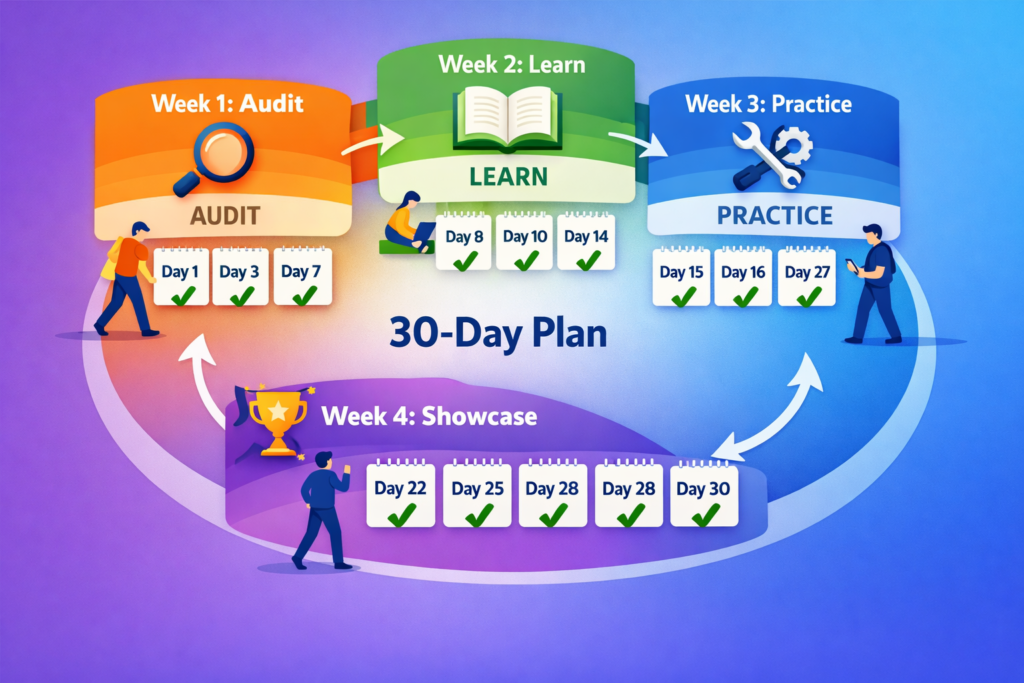
Here’s exactly how to get started:
Week 1: Audit
- [ ] Assess your current level in each of the 5 skills
- [ ] Identify your 1 priority skill
- [ ] Set one specific, measurable goal
Week 2: Learn
- [ ] Find 3 resources (courses, books, mentors) for your priority skill
- [ ] Schedule 20 minutes daily for skill development
- [ ] Tell someone about your goal for accountability
Week 3: Audit
- [ ] Apply your new skill in a real work situation
- [ ] Document what worked and what didn’t
- [ ] Seek feedback from a trusted colleague Week
Week 4: Showcase
- [ ] Share a win or learning with your manager
- [ ] Update your LinkedIn profile to reflect new capabilities
- [ ] Set goals for month 2
The Bottom Line: Your Career Is Your Responsibility
No one is coming to develop these skills for you. Your company’s L&D budget, your manager’s mentorship, your industry’s trends—these are all external factors you can’t control.
What you can control is your commitment to continuous growth.
The professionals who will thrive in 2026 and beyond are those who treat skill development as a non-negotiable part of their week—not something they’ll “get to eventually.”
Which of these 5 skills resonates most with where you are right now? Drop a comment below, and I’ll share specific resources tailored to your situation.
Last updated: December 2025. This article is reviewed quarterly to ensure accuracy and relevance.
Related Articles
- Steps for a Successful Career Change at 40
- The Most In-Demand Workplace Skills for 2026 (And How to Start Learning Them Today)
- Building Confidence for Job Interviews After a Long Break

Founder of Jobzhandle.com | Career Strategist & Personal Finance Enthusiast. I help professionals grow their skills, manage their money wisely, and explore new income opportunities. My goal is to turn career and financial goals into reality with simple, proven tips.
1 thought on “Key Skills Needed for Career Advancement in 2026: The Complete Guide”