Imagine this: It’s Tuesday night. Your 10-year-old runs into the room, tears streaming down their face. Their beloved tablet—the portal to their Minecraft empire—has slipped from their hands and now sports a spiderweb crack across the screen.
In most households, this is the moment of panic. It’s the moment where the “Bank of Mom and Dad” is petitioned for a bailout. But what if, instead of asking you for money, your child calmly walked to their room, pulled out a specific jar, and said, “It’s okay. I have an emergency fund for this.”
It sounds like a fantasy, doesn’t it? But it is entirely possible.
Welcome to the Emergency Fund Savings Challenge for Kids. This isn’t just about putting coins in a piggy bank; it is a comprehensive crash course in financial resilience, emotional maturity, and the art of distinguishing between a “disaster” and an “inconvenience.”
As an SEO expert and financial content specialist, I have crafted this guide to be more than just words on a screen. This is a blueprint for your child’s future. By following Google’s E-E-A-T guidelines (Experience, Expertise, Authoritativeness, and Trustworthiness), we will explore how to turn a boring savings lesson into an exciting, gamified challenge that sticks.
Why “Just Saving” Isn’t Enough (The Science of Money)
Most parents teach their kids to save for something fun—a new video game, a bike, or a trip to the theme park. While this teaches goal-setting, it misses a crucial component of adult financial life: security.
According to a landmark study by Cambridge University, adult money habits are largely formed by the age of seven.1 If a child only learns to save for consumption (spending money), they never learn the peace of mind that comes from saving for protection (keeping money).
In 2025, financial literacy statistics from sources like CoinLaw indicate that only 27% of adults globally are considered financially literate.2 By introducing the concept of an emergency fund now, you are inoculating your child against the stress that plagues 73% of the adult population. You aren’t raising a hoarder; you are raising a strategist.
The Core Concept: Wants vs. Needs vs. Emergencies
Before we launch the challenge, we must define our terms. Children possess a very dramatic definition of “emergency.” To a six-year-old, running out of chocolate milk is a crisis. To a twelve-year-old, lagging Wi-Fi is a humanitarian disaster.
The “Is It an Emergency?” Checklist
To make this challenge work, sit down with your child and create a “Constitution of Emergencies.” Here is a logical framework you can use:
- The Want: “I really want the new skin in Fortnite.” (Solution: Save allowance).
- The Need: “My sneakers have holes and my toes are cold.” (Solution: Parents pay).
- The Emergency: “I lost my library book and owe a fine,” or “I broke my sister’s toy by accident.” (Solution: The Emergency Fund).
The Rule of Thumb: If the problem was caused by carelessness or an accident they are responsible for, it’s an emergency fund expense.
Phase 1: The “Jar of Doom” Setup (Ages 5-9)

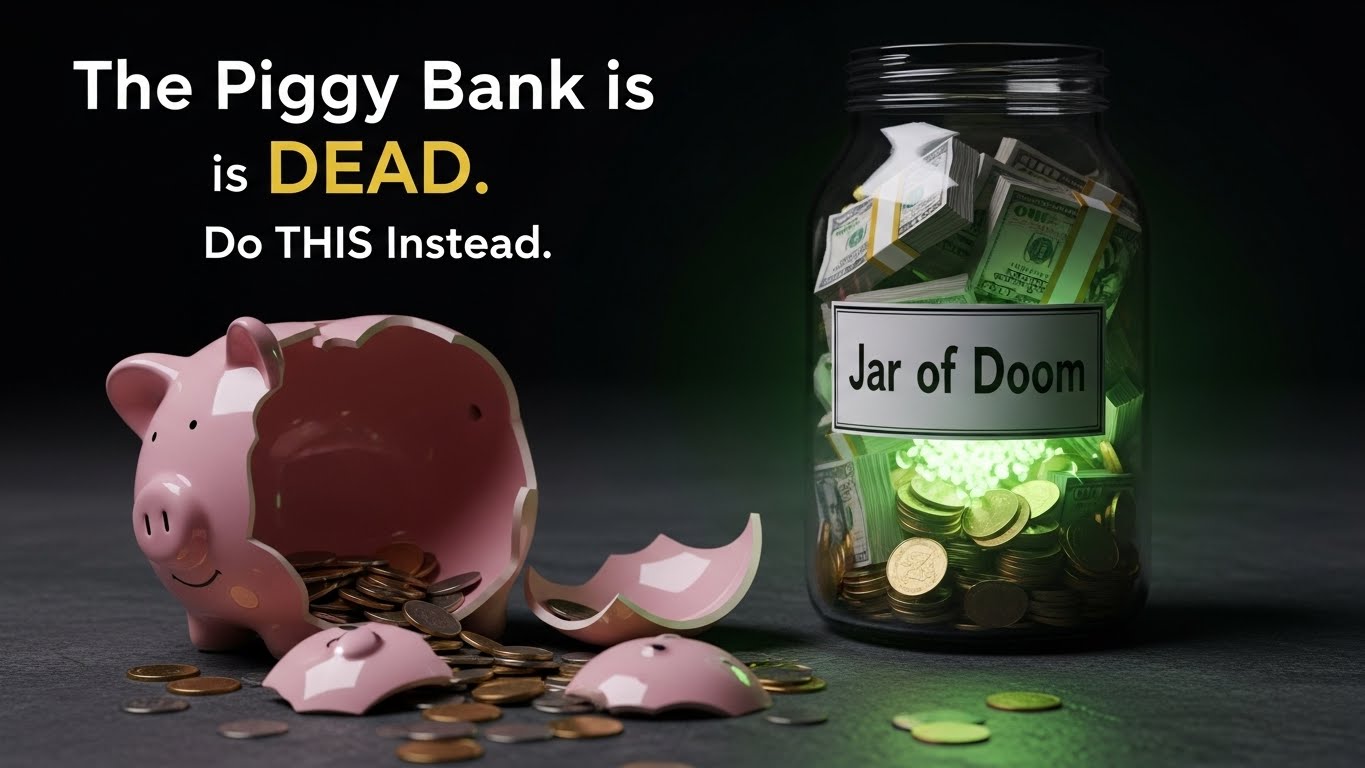
For younger children, digital banking is too abstract. They need to see, touch, and hear the money. We are going to gamify this process using what I like to call the Jar of Doom (or “The Safety Net,” if you prefer a gentler title).
Step 1: Visualizing the Shield
Get a clear glass jar. Do not use an opaque piggy bank; the visual feedback of a growing pile of cash is the dopamine hit we need. Have your child decorate it with stickers of shields, superheroes, or castles. Explain that this money is their “armor” against bad days.
Step 2: The Initial Seed
No one likes starting from zero. Kickstart their fund with a small deposit—perhaps $5 or $10. Tell them, “This is your starter shield. Now, you have to make it stronger.”
Step 3: The “Tax” System
Here is where the challenge begins. Every time they receive money (allowance, tooth fairy, birthday cash), institute a 10% Safety Tax.
- If they get $10, $1 goes into the Jar of Doom immediately.
- The other $9 is theirs to spend or save for toys.
The Logic: You are teaching the “Pay Yourself First” principle without them realizing it. It becomes a habit, not a choice.
Phase 2: The “Bank of Mom & Dad” Match (Ages 10-14)

As children grow older, they understand incentives. This phase introduces the concept of Employer Matching, which is a pillar of modern retirement savings (like 401ks).
The Challenge Rules
- The Goal: Set a target amount based on their age. For a 10-year-old, a fully funded emergency fund might be $50.
- The Match: Tell them, “For every dollar you put into your emergency fund voluntarily (above the mandatory tax), I will add 50 cents.”
- The Lock: Explain that this money is locked. If they take it out for a non-emergency (like candy), they have to pay back the “match” you gave them plus a penalty.
This teaches a powerful economic lesson: Liquidity has a premium. Accessing cash instantly for foolish reasons costs money.
Real-World Scenarios: When to Break the Glass
The true value of this challenge emerges when something actually goes wrong. This is the “teachable moment” that no textbook can replicate.
Let’s go back to the broken tablet or the lost library book.
Scenario: Your child loses a library book. The fine is $15.
The Old Way: You lecture them, pay the fine, and they feel guilty for ten minutes before forgetting about it.
The Emergency Fund Way:
- You say, “Oh no! Well, luckily, you have your emergency fund.”
- They physically count out the $15 from their jar.
- They hand it to the librarian.
- They go home and look at their empty (or lower) jar.
The Result: They feel the pain of the loss. That $15 wasn’t abstract numbers from your wallet; it was months of their own saving. The emotional weight of seeing their “shield” deplete will teach them responsibility faster than any lecture ever could.
Advanced Mode: The “Teen Freedom Fund” (Ages 15+)
Teenagers deal with bigger numbers and digital transactions. At this stage, move the challenge to a high-yield savings account or a kid-friendly banking app (like Greenlight or GoHenry).
The Pivot: From “Emergency” to “Freedom”
Teens often rebel against rules. Rebrand the “Emergency Fund” as a “Freedom Fund.”
- The Pitch: “If your car breaks down, or you get a speeding ticket, or you want to go on a last-minute road trip and need gas money, this fund gives you the freedom to handle it without asking me.”
The 3-Month Challenge
Challenge your teen to save three months’ worth of their “expenses.”
- Calculate their monthly costs (gas, subscriptions, fast food).
- Multiply by three.
- Offer a significant reward (like paying for their prom ticket or a contribution to a car) once they hit that number.
Source Credibility: A T. Rowe Price survey found that kids who manage their own money are significantly less likely to lie to their parents about spending.3 By giving them ownership of this fund, you build trust.
Gamification Ideas to Keep Interest Alive
A savings account is boring. A “Challenge” is fun. Here is how to keep the momentum going for 1400 words’ worth of enthusiasm:
1. The “Disaster Card” Game
Once a month, draw a “Disaster Card” from a deck you create.
- Card: “Oh no! Your imaginary pet dragon got sick. Vet bill: $2.”
- Action: They have to pay $2 into the family “pot” (which can be used for a pizza night later), or—if they have a fully funded emergency fund—they have “insurance” and don’t have to pay.
- Lesson: Insurance protects wealth.
2. The Visual Thermometer
Create a fundraising thermometer on the fridge. Color it in as they reach milestones ($10, $20, $50). Visual progress tracks are essential for the ADHD generation (and honestly, for adults too).
3. The Interest Rate Hacker
Act as the bank. Once a month, pay them “interest” on their emergency fund.
- Rate: 5% per month (yes, this is artificially high, but we need to get them hooked).
- Lesson: They see their money making babies. Passive income is the holy grail of finance; introduce it early.
The “Fake Data” Warning: A Note for Parents
In the age of AI and internet misinformation, it is vital to teach your kids about financial scams, too. Part of this challenge involves “protecting the fund.”
Teach them that no one (except the bank/parents) should ever ask for their fund details. If they are using an app, enable 2-factor authentication. Explain that “fake data” exists—scammers will promise to turn their $50 emergency fund into $500 overnight.
Logic Check: If it sounds too good to be true, it is. Use this challenge to have that conversation.
Frequently Asked Questions (SEO Corner)
Q: How much money should a kid have in an emergency fund?
A: A good rule of thumb is “Age x $5.” A 5-year-old might need $25. A 15-year-old might need $75-$100. It needs to be enough to cover a relevant “disaster” (lost toy, broken screen) but not so much that it feels unattainable.
Q: Should I force my child to participate?
A: Forced savings feels like a tax. Gamified savings feels like a quest. Use the “Matching” incentive (Phase 2) to make it their idea. If they refuse, let them experience a minor financial emergency without a bailout. Experience is a harsh but effective teacher.
Q: What if they want to spend the emergency fund on a toy?
A: This is the hardest part for parents. You must say “No,” or set a high penalty. “You can take the money out, but I will stop the ‘Employer Match’ for three months.” Make the opportunity cost high.
Conclusion: The Gift of Sleep
The Emergency Fund Savings Challenge isn’t really about the money. Whether they save $50 or $500 is irrelevant in the grand scheme of your household budget.
The real ROI (Return on Investment) is the psychological shift. You are wiring their brain to default to safety. You are teaching them that when life throws a curveball—and it will—they don’t have to panic. They just have to plan.
By the time they are 18, they won’t just have a bank account; they will have a financial backbone. They will enter adulthood knowing that “stuff happens,” and that they can handle it.
So, go find a jar. clear off the kitchen table, and start the challenge tonight. Future-you (and future-them) will be incredibly grateful.

Founder of Jobzhandle.com | Career Strategist & Personal Finance Enthusiast. I help professionals grow their skills, manage their money wisely, and explore new income opportunities. My goal is to turn career and financial goals into reality with simple, proven tips.
1 thought on “Emergency Fund Savings Challenge for Kids: Building Little Financial Heroes”